eVTOL.lk
Sri Lanka's advanced air mobility platform
Get in touch

Air ambulance & emergency use

Officials have named emergency services as a use for eVTOL since August 2026. This briefing sets out what today's aircraft can and cannot do for a patient, what the evidence from helicopters and drones says, and what our planner shows for hospital-to-hospital corridors in Sri Lanka.

Updated 23 November 2026

The short version

No eVTOL certified or close to certification can carry a patient lying on a stretcher with a ventilator and two clinicians. The aircraft testing at Port City seats two and flies about 24 km in practice. So the realistic first uses of electric aircraft in Sri Lankan emergency care are three: bringing a doctor or a specialist team to the patient, carrying blood, antivenom, medicines and samples, and moving stable, seated patients between hospitals. Helicopters remain the only way to fly a critically ill patient, at night, or in poor weather.

What exists today

Sri Lanka's emergency care on the ground is strong. The free 1990 Suwa Seriya ambulance service began in 2016 with 88 ambulances funded by India, had answered more than 1.8 million calls by 2023, and reports an average response of 13 to 15 minutes with a fleet heading towards 400. In the air there is far less. Senok Air, described by the trade press as the country's only authorised helicopter emergency medical operator, had flown 400 air ambulance missions by August 2026 from Ratmalana, and the Air Force carries out evacuations when needed. An earlier private helicopter ambulance service, run by Falck, operated from 2013 and withdrew in 2015.

The gap is the transfer that follows the first response. A patient in Hambantota, Nuwara Eliya or Vavuniya who needs a cardiac catheter laboratory, a neurosurgeon or intensive care is usually one to four hours by road from the hospital that has it.

What the evidence says

The research on helicopter ambulances is more cautious than their reputation. A Cochrane review of 38 studies and more than 280,000 patients could not establish an overall survival benefit over ground ambulances for major trauma, though it found a benefit suggested for transfers between hospitals to a higher level of care. That is the situation Sri Lanka's geography creates.

Where electric aircraft have been studied for emergency use, the finding is consistent. A German air rescue study that simulated 26,000 past missions concluded that small electric multicopters should carry doctors, not patients: within a radius of 25 to 30 km a doctor reached the scene about twice as fast as by road, while helicopters were kept for carrying patients. In Rwanda, a national drone network delivering blood to district hospitals was followed by large falls in deaths in hospital from bleeding after childbirth, concentrated near the drone bases. In the United States, the first approved missions for electric vertical aircraft have been organ transport tests and demonstration flights for operators, and in India one manufacturer has a provisional agreement to supply stretcher-capable electric air ambulances, which are not yet certified; in November 2026 it said the aircraft had entered type certification with India's regulator. More

What the planner shows

We modelled six hospital-to-hospital corridors with a four-seat piloted aircraft of the kind expected to be certified later this decade. Flight times are 14 to 30 minutes where the road takes between one and almost four hours. The longer legs use most of the aircraft's practical range one way, so they would need charging at the far hospital.
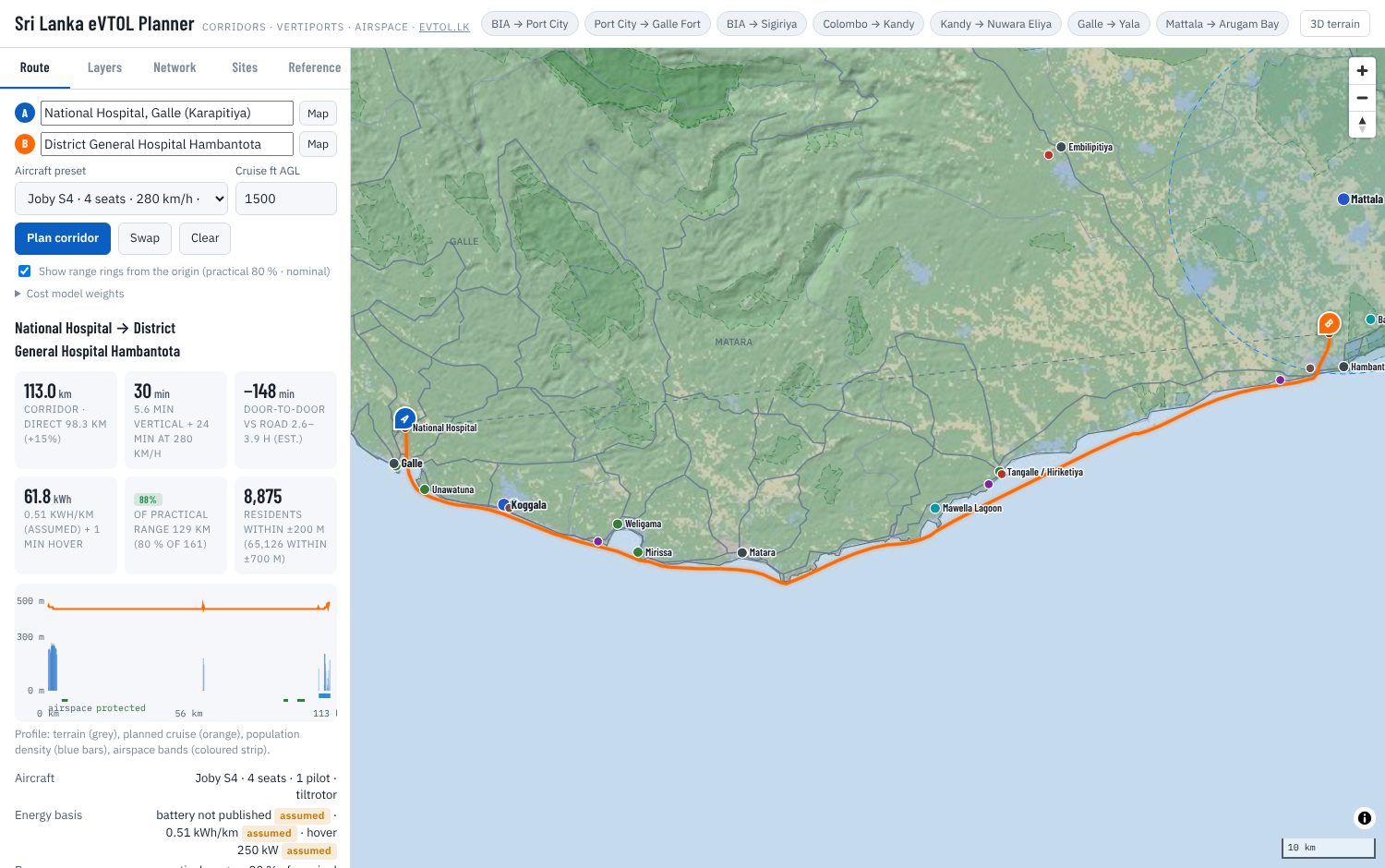
Route planner showing a modelled corridor from National Hospital Galle to District General Hospital Hambantota along the south coast
National Hospital Galle to District General Hospital Hambantota: a 113 km corridor flown in 30 minutes by a four-seat piloted aircraft, 88% of its practical range, against an estimated 2.6 to 3.9 hours by road.

Swipe the table sideways to see every column.

CorridorAircraft presetDirect / corridorFlight timeRoad todayPractical range usedAirspace crossedPlanner
National Hospital Galle → District General Hospital Matara Four-seat piloted class 38.2 / 43.2 km 15 min30 min door to door 1.0–1.5 h estimate 34%of 129 km none (Class G) Open ↗
National Hospital Galle → District General Hospital Hambantota Four-seat piloted class 98.3 / 113.0 km 30 min45 min door to door 2.6–3.9 h estimate 88%of 129 km Mattala CTR Open ↗
National Hospital Kandy → District General Hospital Nuwara Eliyaterrain to 2,430 m; landing at about 1,900 m Four-seat piloted class 38.4 / 40.7 km 14 min29 min door to door 1.0–1.5 h estimate 32%of 129 km VCR19 Open ↗
National Hospital Kandy → National Hospital of Sri Lanka, Colombo Four-seat piloted class 93.7 / 100.4 km 27 min42 min door to door 2.5–3.5 h published range 78%of 129 km VCR19, Colombo CTR, VCR23, VCP29 Open ↗
National Hospital of Sri Lanka → District General Hospital Avissawella Four-seat piloted class 37.7 / 38.9 km 14 min29 min door to door 1.0–1.5 h estimate 30%of 129 km VCP29, VCR23, Colombo CTR Open ↗
Teaching Hospital Anuradhapura → District General Hospital Vavuniya Four-seat piloted class 49.4 / 54.5 km 17 min32 min door to door 1.3–1.9 h estimate 42%of 129 km VCR11, VCR14 Open ↗

Computed in the evtol.lk route planner on 23 Nov 2026. Practical range is 80% of the manufacturer's figure. Road times are estimates at 1.3 times the straight-line distance and 33 to 50 km/h unless marked as a published range. Hospital positions are approximate and none of these hospitals has a verified purpose-built helipad; the National Hospital in Colombo lies inside prohibited area VCP29, so a landing site there would need a standing dispensation. These are planning corridors, not flight plans.

What would have to be true

  • One dispatcher. Programmes that work elsewhere task aircraft from the same control room that sends ambulances, against published criteria. In Sri Lanka that is the 1990 centre.
  • Somewhere to land. A marked pad within a short trolley distance of the emergency department, with charging, at the hospitals that would send and receive patients.
  • Rules for the aircraft and the crew. CAASL is drafting standards for the aircraft now on test; a medical service would also need standards for crew, weather limits and landing sites, and standing airspace arrangements for the areas around Colombo, Kandy and the Air Force stations.
  • Measurement from the first day. Minutes from call to clinician and to definitive care, by district, published every year. Without it nobody can say whether a service is worth its cost.

This page is a briefing built on published sources and our own modelling. It is not medical advice and it does not describe an approved or planned service.

Sources

  1. Newsfirst — "1990 Suwa Seriya Turns 10," 31 Jul 2026
  2. Wikipedia — "Emergency medical services in Sri Lanka" (Suwa Seriya history; Falck 2013–15)
  3. AirMed&Rescue — "Senok Air completes 400 air ambulance missions," 13 Aug 2026
  4. Galvagno et al. — "Helicopter emergency medical services for adults with major trauma," Cochrane Database of Systematic Reviews, 2015
  5. ADAC Luftrettung feasibility study on multicopters in air rescue, as summarised by Volocopter, 14 Oct 2020
  6. "Last-Mile Delivery in Healthcare: Drone Delivery for Blood Products in Rwanda," Manufacturing & Service Operations Management
  7. FAA — "FAA Announces Major Milestone in eVTOL Technology Use" (organ transport test), 14 Jul 2026
  8. eVTOL Insights — "India: ePlane secures USD1 billion order for 788 eVTOL air ambulances," Feb 2025
  9. Urban Air Mobility News — "India's ePlane Company chooses Lynx for mission computing on the e200X eVTOL," 17 Nov 2026
  10. Lanka News Web — medical evacuation and emergency response named among uses under review, 8 Nov 2026
  11. evtol.lk route planner — corridor permalinks and Methods register (routing model v2.1)